

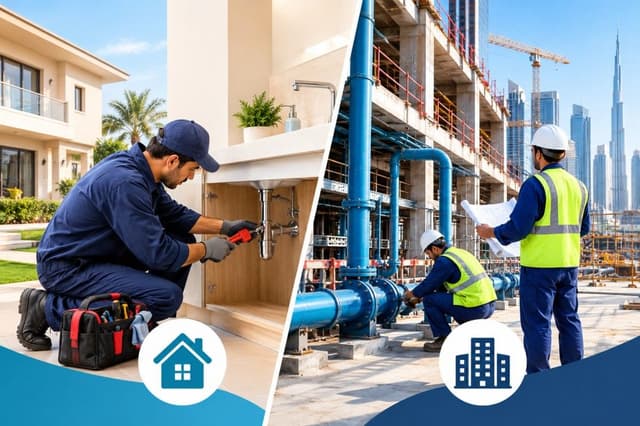
Plumbing work looks similar on paper for a home and a commercial building, but the type of crew each project needs is very different. Knowing the difference helps you brief a plumbing manpower supply UAE provider correctly and check the right skills before workers reach your site. Residential projects involve smaller systems and repeated layouts, while commercial buildings run larger pipes, more fixtures, and tighter coordination between trades. The wrong team will delay and require rework, so you need to think carefully about your choice before you start hiring.
What Does a Plumber Do on a Construction Project?
A plumber installs, tests, and repairs the pipes and fixtures that bring water into a building and carry waste out of it. The work starts early, when lines are laid in slabs and walls, and continues until the handover. Plumbers work from approved drawings, so their output has to match the design.
Main responsibilities include:
Laying water supply, drainage and vent lines.
Fixing basins, water closets, showers and floor drains.
Connecting water heaters, pumps and storage tanks.
Pressure testing pipework before walls and floors are closed.
Coordinating pipe routes with electricians, HVAC crews and civil teams.
Residential vs Commercial Plumbing: What Is the Difference?
Residential plumbing is used in homes, and commercial plumbing is used in buildings that are used by many people at the same time. The difference in scale affects pipe sizes, fixture counts, testing needs, and the level of supervision. Knowing this gap tells you what kind of plumber to look for and how closely to supervise them.
Residential Plumbing
Residential plumbing covers villas, townhouses, and apartment blocks. Systems are smaller, and layouts often repeat from unit to unit. Most work involves bathrooms, kitchens, water tanks and drainage to the main sewer connection.
Commercial Plumbing
Commercial plumbing is for offices, malls, hotels, hospitals and warehouses. Pipe sizes are larger, fixture counts are much higher, and systems such as booster pumps, grease traps and tall drainage stacks are common.One fault can affect several floors or tenants, so the work needs planning, supervision and documented testing.
How Do You Choose Plumbers for Residential Construction?
Make sure that the experience of the home plumbers you choose matches the scale and construction stage of your project. A plumber who has installed water and drainage lines in villas or apartment blocks already knows the common layouts and materials. Check their record on similar homes before you confirm anyone.
Crew size depends on the design, construction stage and programme, so define the scope first. Decide whether you need first fix work (pipes inside walls and slabs), second fix work (fixtures and finishing) or maintenance after handover, since each calls for different experience.
Then check these points:
Pipe materials they have installed, such as PPR and uPVC.
The way they pressure test a line and record the result.
References from recent villa or apartment projects.
Their ability to work from your drawings and specifications.
If your workforce changes from phase to phase, the residential plumber labour supply in Dubai lets you add or release workers as the stages change.
What Should You Look for When Choosing Commercial Plumbers?
Look for plumbers who have worked on large buildings, can read complex drawings, and can coordinate with other trades. Commercial work leaves little room for trial and error, because many users share the large systems. Experience on projects of similar size matters more than general experience.
Check these areas:
Drawings and specifications: Ensure they understand isometric and MEP coordination drawings and specifications for pipe class, insulation, and supports.
Trade coordination: Pipes, cables, and ducts all share the same ceiling and shaft space, making it important for plumbers to coordinate with electricians and HVAC crews.
Testing and commissioning: Pressure tests, flushing, and disinfection of water lines often need written results, so the crew should include a supervisor who can manage those records.
When you compare options, the commercial plumber labour supply in Dubai should provide workers with experience on buildings of a similar size to yours.
What Skills Do Plumbers Need for Residential and Commercial Projects?
Plumbers on both project types need a common set of hands-on skills, and commercial work asks for a few more on top.
Core skills for every project:
Cutting, jointing and installing pipes in PPR, uPVC, copper and steel.
Reading water supply and drainage layouts.
Fitting sanitary fixtures correctly.
Finding and fixing leaks.
Working safely at height and in trenches.
Additional skills for commercial projects:
Installing pumps, valves and large-diameter pipes.
Following installation sequences across many floors.
Ask any provider of plumber labour supply in Dubai for trade test results or references before confirming the crew.
When Should You Use Plumbing Manpower Supply UAE?
Hire supplied plumbers when your project needs more skilled workers than your own team can give, or when you need them fast. This option also suits work that runs for a limited period, where hiring directly would take longer than the job itself.
Common situations include:
Your team is too small for the work, and you need extra plumbers quickly.
Short jobs, such as a single phase or a fit-out, are also common.
The headcount rises and falls between the first fix and finishing.
Difficulty finding workers with a specific trade background.
Not only that, with plumbing manpower supply UAE arrangements, the supplier also handles visas, insurance, and contracts, so you spend less time on paperwork.
How Can You Get the Right Plumber Labour Supply for Your Project?
Start by confirming the project type, the number of plumbers, the skills required, the duration, and the start date, then share those details with a supplier who can match them. Clear requirements let the supplier shortlist suitable workers quickly and avoid mismatches once the crew reaches your site.
Share these requirements with us at ManpowerSupply.ae, and we will help identify plumbers who fit your project needs. As an MOHRE-approved manpower supply company in Dubai, we verify work history and trade skills, provide safety training, and complete the required compliance procedures before deployment.
Nishad Hussain is a visionary entrepreneur and a leading expert in the UAE's manpower supply sector. As the founder and chairman of manpowersupply.ae, he has transformed the company from its humble beginnings in Sharjah into a multifaceted enterprise with a significant presence across the UAE. Under his leadership, manpowersupply.ae has completed over 7,000 projects and collaborated with more than 3,000 clients, contributing to major developments such as the Etihad Railways, Museum of the Future, Al Ain Hospital, Louvre Museum, Expo 2020, and more.